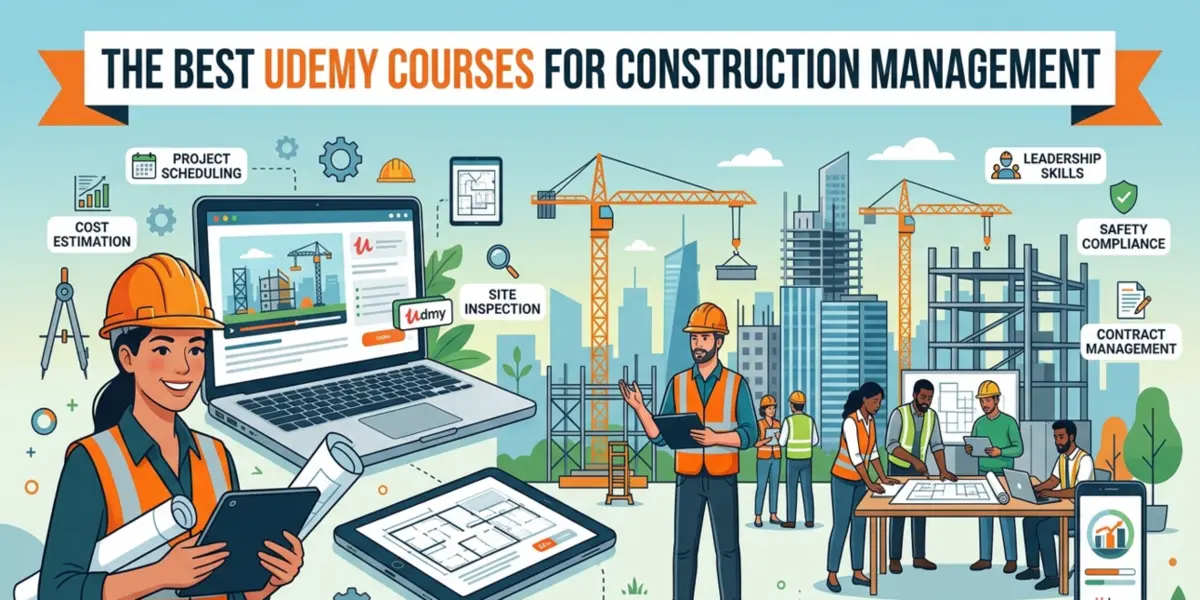
Construction management is one of the most valuable skill sets in the engineering and construction industry.
Whether you are a civil engineer, site engineer, quantity surveyor, architect, contractor, or student, learning construction management can significantly improve your ability to plan projects, control costs, manage teams, and deliver work on time.
Online learning has made professional development much more accessible, and Udemy is one of the most practical platforms for engineers because it offers affordable courses, lifetime access, and downloadable resources.
Many of the best courses are taught by experienced practitioners and focus on real-world tools such as Primavera P6, Microsoft Project, Lean Construction, risk management, and contract administration.
In this guide, you will find the best Udemy courses for construction management, what each course covers, who they are best suited for, and how to choose the right course for your career goals.
Recommended Articles
Why Learn Construction Management?
Construction management combines technical knowledge with leadership and business skills.
A competent construction manager must understand scheduling, budgeting, procurement, quality control, safety, and communication.
The benefits of learning construction management include:
- Better job opportunities
- Higher earning potential
- Improved project delivery skills
- Stronger leadership ability
- Increased confidence on site
- Preparation for management roles
- Enhanced consulting opportunities
Who Is It Best Suited For
The Construction management knowledge is valuable for:
- Civil engineers
- Structural engineers
- Site engineers
- Quantity surveyors
- Architects
- Contractors
- Project planners
- Real estate developers
- Engineering students
Why Choose Udemy for Construction Management Training?
Udemy has become one of the most practical learning platforms for technical professionals.
- Affordable Pricing: Courses are frequently discounted, making them accessible to students and young professionals alike.
- Lifetime Access: Once purchased, you can revisit the course whenever you need a refresher.
- Learn at Your Own Pace: Busy professionals can study in the evenings and on weekends.
- Practical Instruction: Many instructors demonstrate real-world project examples rather than theory alone.
- Certificates of Completion: Certificates can strengthen your resume and LinkedIn profile.
- Mobile Learning: Courses can be accessed from smartphones and tablets.
How to Choose the Best Course On Udemy
Before buying a course, consider the following:
- Your current experience level
- Your target role
- Software you need to master
- Course ratings and reviews
- Number of students enrolled
- Instructor credentials
- Practical exercises and downloadable materials
If you are a beginner, choose a broad introductory course. If you want to become a planning engineer, prioritise courses in Primavera P6 and scheduling. If you intend to lead projects, study contracts, risk, and leadership.
Best Udemy Courses for Construction Management
1. Construction Management Fundamentals
This is the ideal starting point for beginners. It introduces the complete project lifecycle, including planning, procurement, execution, monitoring, and closeout.
Key topics:
The key topics are:
- Project phases
- Stakeholder roles
- Scheduling basics
- Cost control
- Safety management
- Quality assurance
Best for:
- Students
- Graduate engineers
- Junior site engineers
Why take it:
It provides a strong conceptual foundation and makes advanced courses easier to understand.
2. Primavera P6 for Construction Scheduling
Primavera P6 is one of the most widely used scheduling tools on large infrastructure and building projects.
Key topics:
- Work Breakdown Structure (WBS)
- Activity relationships
- Critical Path Method (CPM)
- Resource loading
- Baselines
- Progress updates
Best for:
- Planning engineers
- Project managers
- Site engineers
Why take it:
Scheduling is a highly marketable skill that can substantially increase your earning potential.
3. Microsoft Project for Construction Management
Microsoft Project is popular among small and medium contractors.
Key topics:
- Task creation
- Gantt charts
- Dependencies
- Resource allocation
- Tracking progress
- Reporting
Best for:
- Contractors
- Project coordinators
- Engineers managing smaller projects
Why take it:
It is easier to learn than Primavera P6 and is widely used in practice.
4. Construction Cost Estimating and Budgeting
Accurate cost estimation is essential for profitability and project control.
Key topics:
- Quantity takeoff
- Unit rates
- Labor costs
- Equipment costs
- Overheads
- Contingencies
Best for:
- Quantity surveyors
- Estimators
- Contractors
Why take it:
Strong estimating skills improve tendering accuracy and financial performance.
5. Project Management Professional (PMP) Preparation
Although not construction-specific, PMP concepts are highly relevant to project leadership.
Key topics:
- Scope management
- Schedule management
- Cost management
- Risk management
- Procurement
- Stakeholder engagement
Best for:
- Mid-career engineers
- Project managers
Why take it:
PMP is internationally recognised and can strengthen your professional credibility.
6. Lean Construction Management
Lean construction focuses on minimising waste and maximising value.
Key topics:
- Last Planner System
- Workflow optimization
- Continuous improvement
- Pull planning
Best for:
- Project managers
- Contractors
- Operations leaders
Why take it:
Lean methods can reduce delays, rework, and cost overruns.
7. Construction Contracts and Claims
Understanding contracts is critical to avoiding disputes.
Key topics:
- Contract types
- Variations
- Delay claims
- Extensions of time
- Liquidated damages
Best for:
- Contract administrators
- Project managers
- Consultants
Why take it:
Contract knowledge protects both technical and financial interests.
8. Risk Management in Construction Projects
Construction projects involve technical, financial, and operational uncertainties.
Key topics:
- Risk identification
- Qualitative assessment
- Quantitative analysis
- Mitigation strategies
Best for:
- Project managers
- Engineers
- Developers
Why take it:
Risk management improves decision-making and resilience.
9. Construction Safety Management
Safety is a fundamental responsibility on every project.
Key topics:
- Hazard identification
- Risk assessment
- Toolbox talks
- Incident investigation
- Compliance
Best for:
- Site engineers
- HSE officers
- Contractors
Why take it:
Safety competence is essential for leadership roles.
10. Building Information Modelling (BIM) for Construction Managers
BIM improves collaboration and coordination.
Key topics:
- Model-based planning
- Clash detection
- 4D scheduling
- 5D cost integration
Best for:
- Construction managers
- BIM coordinators
- Engineers
Why take it:
BIM adoption continues to grow worldwide.
11. Earned Value Management (EVM)
EVM integrates schedule and cost performance.
Key topics:
- Planned Value
- Earned Value
- Actual Cost
- CPI and SPI
Best for:
- Project controllers
- Planning engineers
Why take it:
EVM provides objective performance measurement.
12. Quantity Surveying and BOQ Preparation
This course teaches how to prepare bills of quantities and measurement sheets.
Best for:
- Quantity surveyors
- Estimators
- Civil engineers
Why take it:
BOQ skills are highly valuable in tendering and payment certification.
13. Construction Quality Management
Quality management ensures work meets specifications and standards.
Key topics:
- Inspection and test plans
- Non-conformance reports
- Corrective actions
Best for:
- QA/QC engineers
- Site managers
14. Leadership and Communication for Construction Managers
Technical knowledge alone is not enough. Successful managers communicate effectively and lead diverse teams.
Key topics:
- Delegation
- Conflict resolution
- Negotiation
- Team motivation
15. Real Estate Development and Construction Management
This course links development finance with project delivery.
Best for:
- Developers
- Investors
- Senior project managers
Best Course Paths by Career Goal
For Site Engineers:
- Construction Management Fundamentals
- Safety Management
- Quality Management
- Microsoft Project
For Planning Engineers:
- Primavera P6
- Critical Path Method
- Earned Value Management
- Risk Management
For Quantity Surveyors:
- Cost Estimating
- Quantity Surveying
- Contracts and Claims
For Project Managers:
- PMP Preparation
- Leadership and Communication
- Lean Construction
- Risk Management
For Contractors:
- Cost Estimating
- Microsoft Project
- Contracts and Claims
- Safety Management
How Much Do Udemy Courses Cost?
Most Udemy courses are listed at higher prices but are frequently discounted to affordable promotional prices.
Because pricing often changes, it is wise to compare course content, ratings, and instructor reputation rather than focusing only on the list price.
How Long Does It Take to Complete These Courses?
Course durations vary from a few hours to more than 40 hours.
A realistic study plan is:
- 30 minutes per day: 1–3 months
- 1 hour per day: 3–6 weeks
- 2 hours per day: 2–3 weeks
How to Get the Most Value from a Course
- Follow the lectures in sequence
- Complete all exercises
- Download templates and examples
- Apply lessons to real projects
- Take notes
- Review difficult topics
- Add certificates to your resume and LinkedIn
Recommended Learning Roadmap
The following is the learning roadmap:
- Month 1: Construction Management Fundamentals
- Month 2: Microsoft Project or Primavera P6
- Month 3: Cost Estimating and Quantity Surveying
- Month 4: Contracts and Claims
- Month 5: Risk Management and Earned Value Management
- Month 6: Leadership and Communication
Career Benefits of Construction Management Skills
Professionals with construction management expertise are often promoted into roles such as:
- Site Manager
- Planning Engineer
- Project Engineer
- Quantity Surveyor
- Project Manager
- Construction Manager
- Consultant
These roles generally offer better salaries and broader responsibilities.
Can Udemy Courses Help You Get a Job?
Yes, if you combine the courses with practical application. Employers value candidates who can:
- Create schedules
- Prepare cost estimates
- Manage subcontractors
- Track progress
- Administer contracts
- Control risks
The course certificate alone is not sufficient, but demonstrated competence is highly valuable.
Free Alternatives to Complement Udemy
In addition to Udemy, you can strengthen your learning through:
- YouTube tutorials
- Professional association webinars
- Industry books
- Engineering blogs
- Software documentation
Frequently Asked Questions
1. Are Udemy certificates recognised?
They are widely accepted as evidence of continuing education, though they are not professional licenses.
2. Which course should beginners take first?
Construction Management Fundamentals.
3. Which course is best for planning engineers?
Primavera P6 for Construction Scheduling.
4. Which course is best for contractors?
Construction Cost Estimating and Microsoft Project.
5. Is Primavera P6 worth learning?
Yes. It is one of the most in-demand scheduling tools in the construction industry.
6. Can students take these courses?
Yes. Many are designed specifically for beginners.
Final Recommendations
If you are just starting, begin with Construction Management Fundamentals, then move on to scheduling and cost estimating.
If your goal is to specialise, choose courses aligned with your intended role. Planning engineers should prioritise Primavera P6, quantity surveyors should focus on estimating and BOQ preparation, and project managers should study risk, contracts, and leadership.
Suggested Starter Bundle
- Construction Management Fundamentals
- Primavera P6 for Construction Scheduling
- Construction Cost Estimating and Budgeting
- Construction Contracts and Claims
- Leadership and Communication for Construction Managers
Conclusion
The best Udemy courses for construction management can accelerate your professional growth and help you transition from a technical role to a leadership role.
Whether you are a student, site engineer, contractor, or experienced professional, targeted online training can strengthen your scheduling, budgeting, contract, and management skills.
Construction is becoming increasingly complex, and employers need professionals who can effectively coordinate people, processes, and technology.
By investing in high-quality courses and applying what you learn on real projects, you can improve your performance, increase your earning potential, and build a more resilient career in the construction industry.
Tell me. Which Udemy Courses for Construction Management do you prefer? Drop your answer in the comments form below.
Like Our Page On Facebook | Share — to educate another engineer today!
Thats All.