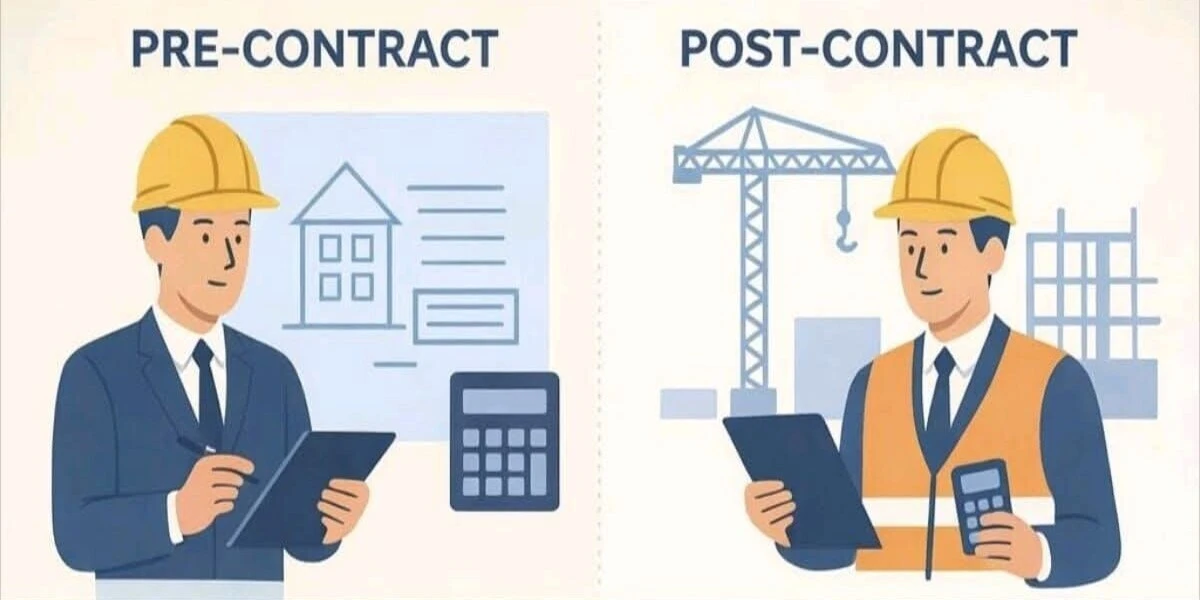
Master pre-contract vs. post-contract engineering management. Key differences, cost-control tools, and risk-mitigation strategies in 2026 explained.
In civil, structural, mechanical, and infrastructure engineering, a project’s success is rarely determined solely by on-site construction.
Long before concrete is poured, structural steel is erected, or software systems are integrated, a complex web of legal, financial, and administrative processes must be established. This overarching operational backbone is known as contract management.
While pre-contract management focuses on defining parameters, estimating costs, allocating risks, and selecting the right contractor, post-contract management centres on administering the signed agreement, managing variations, maintaining quality, controlling budgets, and settling claims.
Failing to manage either phase effectively leads to severe consequences: budget overruns, prolonged arbitration, scope creep, and catastrophic project delays.
Today, we will analyse both stages in depth, compare their deliverables, explore risk management strategies, and examine how modern contract managers navigate this critical transition.
Recommended Articles
- Beyond AutoCAD: The Essential Software For Civil Engineers Needed In 2026
- UDSM vs DIT vs MUST: Which Engineering Pathway in Tanzania Guarantees ERB Licensing and Jobs?
- Tekla Structural Designer vs. ETABS: The US Engineer’s Guide to Complex Seismic & Lateral Design
- Udemy vs Coursera vs edX: Which Platform Is Actually Best for Engineers?
What Is Pre-Contract Management?
Pre-Contract Management encompasses all activities, planning, and documentation undertaken from project inception up to the formal execution (signing) of the contract agreement.
In this phase, the client (employer), consultant engineers, and commercial teams establish the rules of engagement.
The primary objective is to define the project scope, evaluate risks, estimate financial commitments, and secure a competent contractor at a fair, competitive price.
Key Objectives of the Pre-Contract Stage include:
- Scope Alignment: Defining exactly what is to be designed, procured, and built to eliminate ambiguity.
- Risk Allocation: Determining which party (Client, Contractor, or Subcontractor) carries specific risks such as unforeseen ground conditions, material price inflation, or regulatory delays.
- Budget Verification: Establishing an accurate Engineer’s Estimate and developing comprehensive Bills of Quantities (BOQ) or Schedules of Rates.
- Contract Procurement Selection: Choosing the appropriate form of contract (e.g., FIDIC Red Book, Yellow Book, NEC4, or JCT) and procurement strategy (Design-Bid-Build, Design-Build, EPC, or Public-Private Partnership).
Crucial Pre-Contract Deliverables include:
- Tender Documents: Instructions to Tenderers (ITT), Form of Tender, General and Particular Conditions of Contract, Technical Specifications, and Architectural/Engineering Drawings.
- Bill of Quantities (BOQ): Itemised breakdown of labour, materials, and equipment required based on standard measurement rules (e.g., NRM2, CESMM4).
- Pre-Qualification Questionnaire (PQQ): Screening documentation to evaluate contractors’ financial stability, technical capacity, and safety records.
- Tender Evaluation Report: Technical and commercial analysis of submitted bids to recommend the optimal award choice.
Main Phases of the Pre-Contract Lifecycle
Phase 1: Inception & Feasibility
- Client Brief: Define the project purpose, budget limits, target timeline, and performance criteria.Site
- Investigations: Geotechnical soil studies, topographical surveys, environmental impact assessments (EIA), and site access reviews.
- Feasibility & Budgeting: Conduct initial cost planning, financial viability studies, and life-cycle cost estimates.
Phase 2: Design & Scope Development
- Conceptual & Detailed Design: Architects and engineers create working drawings, structural calculations, and mechanical/electrical specifications.
- Value Engineering: Analyse materials and design choices to optimise costs without compromising quality or safety.
- Measurement & Quantity Surveying: Produce detailed Bills of Quantities (BOQ) or schedules of rates based on finalised production drawings.
Phase 3: Procurement & Tendering
- Procurement Strategy Selection: Decide on the contracting model (e.g., Design-Bid-Build, Design-Build, EPC, Turnkey, Management Contracting).
- Prequalification (PQQ): Shortlist qualified contractors based on technical expertise, financial standing, safety track record, and past performance.
- Tender Package Assembly: Issue the complete tender dossier containing:
- Instructions to Tenderers
- Form of Tender
- General and Particular Conditions of Contract
- Technical Specifications & Working Drawings
- Unpriced Bill of Quantities (BOQ)
Phase 4: Tender Evaluation & Contract Negotiation
- Tender Submission & Opening: Receive sealed technical and commercial bids.
- Commercial & Technical Appraisal: Compare rates, evaluate methodology, inspect proposed key personnel, and check arithmetic accuracy.
- Pre-Contract Meetings & Clarifications: Negotiate ambiguities, finalise scope exclusions, resolve qualifications/reserving clauses, and align schedules.
- Letter of Acceptance & Signing: Issue the formal Letter of Award (LoA) and execute the final signed contract documents.
Essential Pre-Contract Documentation
The essential Pre-Contract documentation is:
| Document | Purpose / Function |
| Employer’s Requirements / Scope of Work | Defines what the client wants built, including functional parameters. |
| Bill of Quantities (BOQ) | Itemizes material, labor, and plant quantities for uniform tender pricing. |
| Conditions of Contract | Sets legal terms (e.g., FIDIC Red/Yellow Book, NEC4) regarding payments, claims, and risks. |
| Project Master Schedule | Outlines baseline milestones, completion targets, and liquidated damages thresholds. |
| Risk Register | Identifies technical, environmental, or regulatory risks and delegates responsibility. |
What Is Post-Contract Management?
Post-Contract Management (often termed Contract Administration) begins the moment the contract is signed by all parties and continues through mobilisation, construction, defect notification, and final financial settlement.
Once the contract is active, the focus shifts from strategy and estimation to execution, compliance, and control.
The primary objective is to ensure that all parties perform their contractual obligations—the contractor builds according to specifications and schedule, while the client pays promptly for verified, completed work.
Key Objectives of the Post-Contract Stage
- Change and Variation Management: Assessing, pricing, and approving or rejecting modifications to the original scope of work.
- Progress Valuation & Payment Certification: Verifying work executed on site and issuing Interim Payment Certificates (IPCs).
- Schedule & Time Control: Monitoring project progress against the approved Baseline Programme, evaluating requests for Extension of Time (EOT), and managing liquidated damages (LDs).
- Quality & Compliance Assurance: Ensuring materials, workmanship, and safety procedures meet the technical specifications set during the pre-contract stage.
- Dispute Resolution & Settle Final Account: Managing claims early through informal negotiation, Dispute Avoidance/Adjudication Boards (DAB/DAAB), or formal arbitration.
Crucial Post-Contract Deliverables
- Interim Payment Certificates (IPCs): Formal progress payment approvals based on joint site measurements.
- Variation Orders (VOs): Written instructions modifying the scope, design, or timing of the works.
- Request for Information (RFI) & Submittals: Official technical clarifications, material samples, and shop drawing approvals.
- Practical Completion Certificate (PCC) / Taking-Over Certificate (TOC): Official declaration that the works are substantially complete and ready for client operation.
- Final Statement & Final Account: The ultimate financial reconciliation balancing all payments, variations, claims, and retention releases.
Pre-Contract vs. Post-Contract: Side-by-Side Comparison
To clearly understand how responsibilities shift between these two phases, examine the comparative breakdown below:
| Feature / Criteria | Pre-Contract Management | Post-Contract Management |
| Primary Focus | Planning, scope definition, estimation, tendering, and risk allocation. | Execution, cost control, progress monitoring, change management, and dispute avoidance. |
| Time Horizon | Project Inception to Contract Signing/Award. | Contract Execution through Construction to Final Account Settlement. |
| Key Stakeholders | Client, Lead Design Consultants, Quantity Surveyors (QS), Estimators, Bid Managers. | Resident Engineers, Project Managers, Site Quantity Surveyors, Main Contractor, Subcontractors. |
| Primary Governing Document | Draft Contract Terms, Tender Packages, Bills of Quantities (BOQ), Specifications. | Executed Agreement, Baseline Schedule, Issued for Construction (IFC) Drawings, Site Logs. |
| Financial Control Mechanism | Cost Planning, Pre-Tender Estimates, Value Engineering, Tender Analysis. | Cashflow Forecasting, Interim Valuations (IPCs), Variation Pricing, Claim Evaluation. |
| Risk Management Approach | Preventative: Structuring contract clauses, insurance requirements, and indemnities. | Reactive / Operational: Managing unforeseen site conditions, delays, variations, and claims. |
| Handling Scope Changes | Addenda / Addendum circulars issued during the bidding process. | Formal Variation Orders (VOs), Change Requests, and Design Modifications. |
| Success Metric | Awarding a legally robust, well-priced contract to a qualified contractor on schedule. | Delivering the physical project on budget, on time, to technical specification without litigation. |
How Pre-Contract Decisions Impact Post-Contract Performance
A common pitfall in engineering organisations is operating pre-contract and post-contract teams in isolated silos.
When estimators and commercial managers complete a tender and hand it over to the site team without proper alignment, project risk increases significantly.
Ambiguous BOQ Items Lead to Immediate Claims
If a pre-contract quantity surveyor leaves descriptions vague in the Bill of Quantities or uses inaccurate provisional sums, the contractor’s post-contract commercial team will exploit these loopholes.
What was overlooked during tendering becomes the foundation for costly Variation Orders on site.
Example: A pre-contract team specifies “excavation in all types of ground” without providing comprehensive geotechnical soil investigation reports.
Post-contract, the contractor encounters hard granite rock, triggering a substantial claim for extra costs and an Extension of Time (EOT).
Flawed Contract Selection Creates Administrative Friction
Selecting an inappropriate standard form of contract during the pre-contract phase causes severe administrative bottlenecks during execution.
For instance, using a traditional lump-sum contract (e.g., FIDIC Red Book) for a project with incomplete engineering drawings forces the post-contract team to process endless scope variations, destroying the original budget.
Unrealistic Baseline Schedules
When pre-contract teams accept an overly aggressive, unachievable construction schedule simply to meet a political deadline, the post-contract execution team is placed in an untenable position.
The result is rapid disruption, acceleration costs, delayed milestones, and inevitable disputes over liquidated damages.
Common Risks and Mitigation Strategies in Both Phases
Understanding where engineering projects fail allows commercial managers to build robust controls across both phases.
Pre-Contract Risks & Mitigations
- Risk: Incomplete or Uncoordinated Design Drawings
- Impact: Major variations, scope gaps, and contractor claims during construction.
- Mitigation: Implement rigorous 3D Building Information Modelling (BIM) clash detection and complete thorough inter-disciplinary design reviews prior to releasing tender packages.
2. Risk: Abnormally Low Bids (Under-Bidding)
- Impact: Contractor insolvency, poor workmanship, or aggressive claim tactics post-award.
- Mitigation: Conduct detailed tender arithmetic checks and establish financial sanity-check boundaries against the Engineer’s Estimate.
Post-Contract Risks & Mitigations
- Risk: Uncontrolled Scope Creep and Unauthorised Site Instructions
- Impact: Budget overruns caused by informal verbal agreements made by site staff.
- Mitigation: Enforce a strict written Variation Protocol. No physical work on modified scope must proceed without an official, written Variation Order signed by the authorised Engineer/Project Manager.
2. Risk: Delays in Processing Interim Payment Certificates (IPCs)
- Impact: Contractor cash flow bottlenecks, leading to slowdowns, suspension of work, or interest penalties on late payments.
- Mitigation: Digitally automate joint measurement verification and stick to strict contractual turnaround windows for payment valuation and certification.
FAQs: Pre-Contract vs. Post-Contract Management
1. What is the difference between a Pre-Contract QS and a Post-Contract QS?
A Pre-Contract Quantity Surveyor (QS) focuses primarily on cost planning, feasibility studies, taking off quantities from drawings, preparing Bills of Quantities (BOQ), compiling tender documents, and analysing incoming bids. A Post-Contract QS works on site or in project administration, handling monthly payment valuations, measuring executed works, pricing variations, managing sub-contractor accounts, and negotiating final accounts.
2. Does the Pre-Contract phase end when the tender is awarded?
Not strictly. The pre-contract phase officially concludes when the contract agreement is formally executed (signed) by both the Employer and the Contractor, and all pre-conditions (such as providing performance bonds and advance payment guarantees) are satisfied.
3. Which phase is more important for cost control?
While post-contract cost control prevents leakages during execution, the pre-contract phase has a far greater influence on final cost. Up to 80% of a project’s cost commitment is locked in during initial design, procurement selection, and scope definition. Changes made during the pre-contract stage cost significantly less to implement than variations ordered during active site construction.
4. What standard forms of contract are widely used in engineering?
International engineering projects frequently utilise standard contract suites such as:
1. FIDIC (International Federation of Consulting Engineers) – e.g., Red Book (Construction), Yellow Book (Plant & Design-Build), Silver Book (EPC/Turnkey).
2. NEC4 (New Engineering Contract) – widely used for collaborative risk management.
3. JCT (Joint Contracts Tribunal) – standard in UK building works.
Conclusion: Bridging the Gap for Project Success
Pre-contract and post-contract management are not separate disciplines; they are two halves of a single, continuous project management lifecycle.
- Pre-contract management establishes the foundation—defining scope, calculating estimates, and allocating risk fairly.
- Post-contract management builds the structure—administering the rules, verifying quality, managing changes, and safeguarding cash flow.
Engineering firms, clients, and contractors that bridge the gap between these phases through collaborative risk reviews, transparent documentation, and modern digital platforms significantly reduce disputes, protect profit margins, and consistently deliver infrastructure projects on time and within budget.
Like Our Page on Facebook | Pinterest | Share — to educate another engineer today and more.
Thats All.