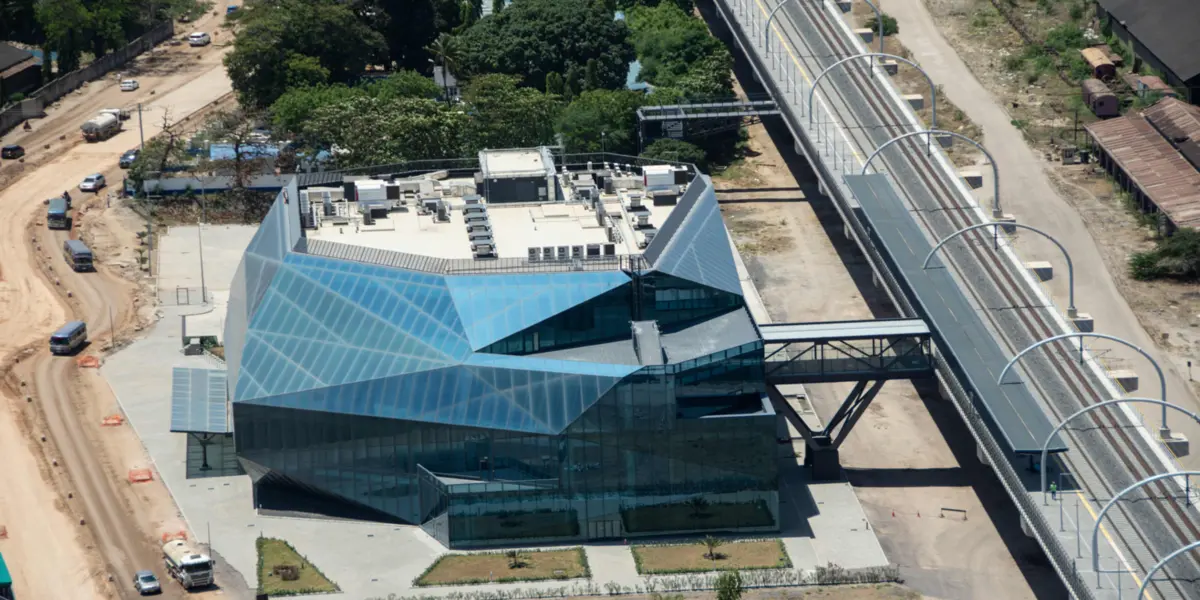
For decades, the economic landscape of East Africa has been bound by logistical constraints. Moving freight and passengers from the coastal ports to landlocked interior nations meant navigating thousands of kilometres of ageing road networks or relying on historic, narrow-gauge rail systems with severely limited speeds and weight capacities.
Tanzania is radically redefining this dynamic. The Tanzania Standard Gauge Railway (SGR) Project is a historic, multi-billion-dollar infrastructure megaproject aimed at constructing a modern, electrified railway network spanning over 2,500 kilometres.
By linking the bustling port city of Dar es Salaam with the administrative capital of Dodoma and extending to Mwanza, Rwanda, Burundi, and the Democratic Republic of Congo (DRC), this network serves as a massive economic catalyst for the entire continent.
For engineers, logistics professionals, and infrastructure stakeholders, the Tanzania Standard Gauge Railway is a masterclass in modern civil engineering, heavy rail logistics, and regional project management.
This comprehensive guide breaks down the project’s engineering specifications, multi-phase rollout, economic impacts, and the technical milestones that define this monumental network.
Recommended Articles
- Best Paint Brands in Tanzania: A Complete Guide for Homeowners, Builders, and Contractors
- Best Side Hustles for Civil Engineers in 2026
- The Pinnacle of African Higher Education: The Guide to the University of Cape Town
- 10 Useful Smartphone And Tablet Applications For Engineers
- 50 Construction Site Problems and Solutions: The Quick Guide
- Key Skills Every Civil Engineer Need To Learn In 2026
- From Graduate to Professional Engineer: The 3-Year Blueprint
- Construction Management vs Civil Engineering vs Quantity Surveying: The Career Paths
- Best Drones for Surveying and Mapping: Guide for Engineers
Project Background and Structural Vision
To appreciate the scale of the Standard Gauge Railway, one must first understand what it replaces. Historically, Tanzania relied on the Central Line, a Meter-Gauge Railway (MGR) built during the colonial era.
The MGR features a rail track width of exactly 1,000 mm (1.0m). While functionally vital for over a century, meter-gauge systems suffer from inherent physics limitations: they cannot safely support heavy axle loads or sustain the high speeds required for modern, high-throughput freight and passenger transit.
The new network utilises the international Standard Gauge width of 1,435 mm (1.435m). This wider footprint provides a highly stable centre of gravity, allowing the infrastructure to handle significantly higher dynamic forces, safely support massive freight trains, and achieve passenger travel speeds up to 160 km/h.
Managed by the Tanzania Railways Corporation (TRC), the project aims to establish an efficient, eco-friendly transport corridor.
It reduces transit times across the country from days to hours, positioning Tanzania as the primary logistical hub for East and Central Africa.
Technical and Engineering Specifications
The Tanzania Standard Gauge Railway is not simply a replacement for tracks; it is a fully modern, high-tech rail network designed to meet global technical standards.
Electrification and Power Infrastructure
Unlike many regional rail networks that rely entirely on diesel-electric locomotives, the Tanzania Standard Gauge Railway is fully electrified. The system operates on an overhead catenary system supplied with 25 kV Alternating Current (AC) at 50 Hz.
To power this massive line without straining the municipal civilian grid, the network draws power directly from dedicated high-voltage transmission lines, with substantial support from the Julius Nyerere Hydropower Project (JNHPP), which generates 2,115 MW of clean energy.
The electric locomotives feature advanced regenerative braking systems, which capture kinetic energy during deceleration and feed it back into the catenary grid, reducing overall power consumption by up to 15%.
Track Structure and Axle Loads
The civil engineering design of the track is optimised for long-term durability and heavy-haul performance:
- Rail Profile: Heavy-duty UIC 60 continuous welded rails (CWR) to eliminate the traditional joint gaps, ensuring a smooth ride, minimising mechanical wear, and reducing maintenance overhead.
- Sleeper Technology: Monoblock prestressed concrete sleepers, weighing roughly 300 kg each, spaced precisely to distribute dynamic loads evenly into a deep, high-quality crushed basalt ballast bed.
- Axle Load Capacity: Engineered to support a 35-ton axle load limit. This allows a single Standard Gauge Railway freight train to pull up to 10,000 tons of cargo—the equivalent of displacing up to 500 long-haul cargo trucks from Tanzania’s highway network.
Signalling and Control Systems
Safety and scheduling efficiency are governed by the European Train Control System (ETCS) Level 2. This advanced digital framework eliminates the need for physical lineside signals.
Instead, tracks are embedded with electronic balises that communicate continuous, real-time speed limits, track conditions, and positional data directly to the driver’s cabin interface via a dedicated Global System for Mobile Communications-Railway (GSM-R) wireless network.
If a train exceeds its authorised safety envelope or detects an obstacle ahead, the central control system can automatically engage the pneumatic braking systems to prevent collisions.
The Multi-Phase Development Blueprint
Given the immense geographic span and multi-billion-dollar capital requirements, construction of the main line is organised into distinct, highly structured phases.
This phased rollout allows finished sections to be tested, commissioned, and opened for commercial operations while engineering teams continue pushing further inland.
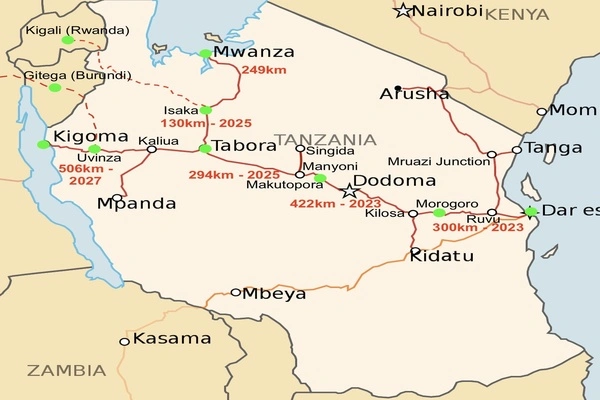
Phase 1: Dar es Salaam to Morogoro (202 km)
This critical foundational phase connects the Indian Ocean port of Dar es Salaam with the agricultural and regional hub of Morogoro.
Navigating the dense urban layout of Dar es Salaam required extensive civil works, including elevated viaducts to bypass street-level traffic, deep drainage systems to resist tropical monsoon flooding, and massive passenger terminals. This section serves as the primary testing ground for the network’s electrified rolling stock.
Phase 2: Morogoro to Makutupora (422 km)
Pioneered by the Turkish engineering firm Yapi Merkezi, Phase 2 pushes through challenging terrain, climbing from the low coastal plains through the scenic, mountainous topography of the Rift Valley towards the capital region.
- Key Civil Engineering Feat: Building extensive tunnels, deep rock cut-and-fill sections, and long concrete bridges to maintain a strict, minimal gradient angle required for high-speed freight trains. This phase brings the rail line directly to Dodoma, the administrative heart of the country
Phase 3: Makutupora to Tabora (368 km)
This phase cuts directly across the dry central plateau, linking the capital region with Tabora, a historic logistics hub in western Tanzania.
The construction layout focuses on high-speed track laying, extensive wildlife underpasses to protect seasonal migration paths, and strategic power substations to maintain voltage stability across remote stretches.
Phase 4: Tabora to Isaka (165 km)
A shorter but strategically critical link, Phase 4 runs northwest from Tabora to the town of Isaka. Isaka is designed to be a massive dry port and inland container depot (ICD).
From this point, the railway splits into strategic branches, providing future connection points directly to the borders of Rwanda and Burundi.
Phase 5: Isaka to Mwanza (341 km)
This northern phase connects the Isaka dry port directly to the shores of Lake Victoria at Mwanza. By linking the Indian Ocean port of Dar es Salaam to Lake Victoria via a fast, electrified rail link, this phase creates a multi-modal transport network.
Cargo can move quickly by rail across Tanzania, then be loaded onto lake barges to reach Uganda and western Kenya efficiently.
Operational Rolling Stock and Locomotives
To match the high-capacity civil engineering track design, the Tanzania Railways Corporation has acquired a modern fleet of specialised electric rolling stock tailored for both fast passenger transit and heavy freight haulage.
Electric Multiple Units (EMUs)
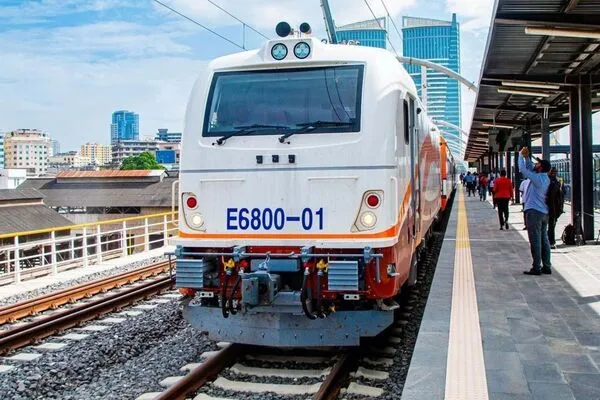
For rapid passenger transport along the core Dar es Salaam–Morogoro–Dodoma corridor, Tanzania utilises modern Electric Multiple Units (EMUs) procured from premier global manufacturers, including Hyundai Rotem.
These trains feature an aerodynamic nose cone design to minimise wind resistance at high speeds, modern interior climate control systems to handle tropical heat, and advanced active suspension systems to ensure high passenger comfort at 160 km/h.
Heavy-Haul Electric Locomotives
For freight operations, the network utilises ultra-high-power electric locomotives built to deliver immense tractive effort.
These engines pull lines of double-stack container wagons, bulk mineral carriers, and fuel tankers. Operating with a continuous power output exceeding 5,000 kW, these locomotives easily pull heavy freight trains up the steep terrain of the East African Rift Valley without losing scheduling momentum.
Socio-Economic Transformations and Regional Impact
The Standard Gauge Railway is fundamentally an economic transformation project wrapped in a civil engineering package. Its operational benefits ripple across multiple sectors of the domestic and regional economy.
Drastic Reduction in Transit Logistics Costs
Historically, moving cargo by road freight from Dar es Salaam to Kampala or Kigali added high costs to basic consumer goods and industrial components due to diesel consumption, mechanical wear on truck fleets, and administrative delays at border crossings.
The Standard Gauge Railway reduces total cargo transit times from several days down to less than 24 hours. This massive increase in logistical velocity lowers supply chain costs, making Tanzanian businesses highly competitive globally.
Environmental Decarbonisation
By shifting the primary transport burden from diesel-powered long-haul trucks to an electrified rail network powered by renewable hydropower, Tanzania is significantly reducing its national carbon footprint.
A single electric freight train removes hundreds of carbon-emitting trucks from the highways, cutting carbon emissions, reducing urban traffic congestion, and preserving highway infrastructure from premature pavement damage.
Boosting Landlocked Regional Economies
Tanzania’s geographical position makes it a natural maritime gateway for landlocked neighbours, including Rwanda, Burundi, Uganda, and the eastern Democratic Republic of Congo.
By extending the Standard Gauge Railway tracks directly to inland container depots near these borders, Tanzania provides its neighbours with a fast, reliable connection to global maritime trade routes through the expanded Port of Dar es Salaam.
Challenges, Solutions, and Lessons in Project Management
Executing an infrastructure project of this magnitude in an emerging economy presents a unique set of challenges.
Examining how the TRC and its engineering partners navigate these hurdles offers invaluable lessons for global project management.
Navigating Soft Soil and Flooding in Coastal Lowlands
The initial stretches of track leaving the coastal plains of Dar es Salaam cross areas with high water tables and soft, compressible clay soils.
During the intense tropical rainy seasons, these areas face significant flooding risks.
- The Engineering Solution: Geotechnical teams implemented deep soil stabilisation techniques, driving thousands of stone columns and concrete piles deep into the ground to anchor the track bed. Furthermore, designers raised the main rail embankment well above historic 100-year flood levels and built an extensive network of concrete box culverts and drainage channels to direct storm water away from the ballast.
Managing Project Financing and Macroeconomic Shocks
Securing billions of dollars in stable, long-term financing over a multi-year construction timeline exposes a project to global economic shifts, currency fluctuations, and supply chain disruptions.
- The Management Solution: Tanzania utilised a diversified financing strategy, blending direct government budget allocations with strategic soft loans from international export credit agencies, European development banks, and commercial consortia. This diversified approach keeps construction moving steadily forward even during periods of global market volatility.
The Tool Selection Matrix for Standard Gauge Railway Infrastructure
Building and maintaining an electrified Standard Gauge Railway network requires an array of advanced software tools and engineering frameworks to manage design, scheduling, and asset health.
| Project Domain | Standard Architectural Tool | Core Engineering Application |
| Track Alignment & Geometric Design | Bentley Rail Track / Autodesk Civil 3D | Calculating exact horizontal and vertical curves, cant gradients, and mass-haul earthwork balances. |
| Power Grid Simulation & Catenary Design | ETAP / Siemens Sicat Master | Modeling voltage drops across long distances, substation spacing, and dynamic catenary-pantograph interactions. |
| Structural Bridge & Tunnel Analysis | Midas Civil / ANSYS | Conducting finite element analysis (FEA) on prestressed concrete viaducts and tunnel lining rock mechanics. |
| Master Scheduling & Resource Planning | Primavera P6 / TILOS | Tracking linear construction progress across hundreds of kilometers, managing supply chains for ballast and rails. |
| Signaling & Train Traffic Simulation | OpenTrack | Simulating ETCS Level 2 headway times, train braking curves, and optimising power consumption. |
Frequently Asked Questions (FAQs): Standard Gauge Railway
Q1: What is the maximum speed of trains on the Tanzania Standard Gauge Railway?
A: The railway infrastructure is engineered to support maximum speeds of 160 km/h for passenger trains and 120 km/h for heavy freight trains. This drastically reduces the travel time between Dar es Salaam and the capital city of Dodoma, from an 8- to 10-hour drive to a comfortable 3- to 4-hour train ride.
Q2: How is the Standard Gauge Railway powered, and what happens during a civilian power blackout?
A: The Standard Gauge Railway is powered via an overhead 25 kV AC catenary system supplied by dedicated high-voltage transmission lines connected directly to major national power stations, primarily the Julius Nyerere Hydropower Project (JNHPP). To prevent operational disruptions during civilian grid failures, the TRC has integrated independent backup gas-insulated substations (GIS) and backup power systems along the line to ensure the signalling, communication, and train control networks remain fully operational.
Q3: Why did Tanzania choose an electrified rail system over cheaper diesel-electric trains?
A: While diesel-electric trains have lower initial upfront capital costs, fully electrified rail systems offer significantly lower long-term operational costs, higher energy efficiency, and superior torque performance for heavy-haul freight climbs. Additionally, switching to electricity allows Tanzania to tap into its abundant domestic renewable hydropower resources, thereby eliminating reliance on imported fossil fuels and drastically reducing national transport carbon emissions.
Q4: How does the Standard Gauge Railway handle wildlife conservation across remote national corridors?
A: Environmental and civil engineers conducted comprehensive Environmental and Social Impact Assessments (ESIA) during the design phase. To protect seasonal wildlife migration routes across central Tanzania, the railway embankment is raised on long concrete viaducts and elevated bridges in critical conservation zones, creating spacious wildlife underpasses that allow animals to move safely beneath the electrified tracks without risk of collision or electrocution.
Q5: Will the historic Meter-Gauge Railway (MGR) be completely abandoned?
A: No, the historic Meter-Gauge Railway will not be abandoned. Instead, the TRC is actively rehabilitating key sections of the MGR to act as a complementary feeder network. The MGR will handle local freight routing, connect smaller industrial zones, and link agricultural centres directly to major Standard Gauge Railway transhipment hubs, creating a comprehensive, multi-tiered rail network across the country.
Conclusion: Tanzania’s Standard Gauge Railway
True engineering excellence is measured by its long-term impact on society. The Tanzania Standard Gauge Railway Project stands as a powerful symbol of modern African engineering capability, strategic vision, and economic determination.
By replacing century-old colonial infrastructure with a fully electrified, standard-gauge, digitally controlled network, Tanzania is building the foundational architecture for long-term prosperity.
The project demonstrates how modern civil engineering, when backed by clear political will and sustainable financing, can transform geographical challenges into powerful economic corridors.
As the tracks continue to push further inland toward the borders of East and Central Africa, the Standard Gauge Railway will cease to be just a Tanzanian railway—it will become the primary steel artery driving trade, unity, and development across the entire African continent.
That’s All.
Tell us anything about the Standard Gauge Railway. Drop your answer in the comments form below.
Like Our Page on Facebook | Share to educate another engineer.