Selecting the appropriate foundation type is a critical engineering decision that depends primarily on the soil’s physical and mechanical properties.
The soil strength must be able to support the building’s load without undergoing excessive settlement or shear failure.
The success of any structure begins below ground. No matter how strong the columns, beams, or slabs are, a building will fail if its foundation is not compatible with the supporting soil.
For every Civil Engineering project, whether a residential house, commercial building, bridge, or industrial facility, the relationship between foundation type and soil type is one of the most critical design considerations.
Recommended Articles
- The Best 6 AI Healthcare Software Development Companies
- The 10 Usefully Measuring Tools and Equipment Right Now
- Building construction | Types of Building construction
- Building Materials: Types, Properties, and Uses all Engineers Should Know
- Precast vs. Cast-in-Situ Concrete: What You Need To Know
- Everything You Need To Know About Ready-Mix Concrete (RMC)
- 50 Construction Site Problems and Solutions: The Quick Guide
- From Graduate to Professional Engineer: The 3-Year Blueprint
Foundation Type
![Foundation Type vs Soil Type Tips You Need To Know [2026]](https://websiteforengineers.com/wp-content/uploads/2026/05/Foundation2.jpg "Foundation2")
Stop Guessing Your Foundation Type
This is where MOST construction mistakes begin. Not in the beam. Not in the column.
But right under your feet.
The Truth Most Engineers Ignore
In the case of Foundation type, choosing between SHALLOW and DEEP foundation is not about budget. It’s about SOIL + LOAD + SAFETY.
Wrong Choice is Equal to Disaster
The wrong choice of foundation type vs Soil Type can cause the following:
Smart Engineers Should Know This
Shallow Foundations are used when the soil near the surface is STRONG. The types of shallow foundations are:
- Isolated footing
- Strip footing
- Raft (mat) foundation
- Wall footing foundation
- Strap or Cantilever footing foundation
- Continuous footing foundation
- Grillage foundation
- Stepped foundation
Deep Foundations are used when the surface soil is WEAK
- Pile foundation
- Pier (caisson) foundation
In deep foundations, the load is transferred to deeper, stronger layers of soil.
Real Site Secret
If your building is sinking slowly, there’s a 90% chance the foundation type was WRONG.
Rule To Remember
Don’t design what you see, design what is BELOW.
Shallow vs Deep Foundations
| Factor | Shallow Foundation | Deep Foundation |
|---|---|---|
| Construction Cost | Lower | Higher |
| Construction Speed | Faster | Slower |
| Suitable Soil Depth | Strong soil near surface | Strong soil at depth |
| Settlement Control | Moderate | Excellent |
| Equipment Requirement | Basic | Specialized |
Soil Type
![Foundation Type vs Soil Type Tips You Need To Know [2026]](https://websiteforengineers.com/wp-content/uploads/2026/05/Foundation-Type-vs-Soil-Type-Tips-You-Need-To-Know.webp "Foundation Type vs Soil Type Tips You Need To Know")
Most people admire the structure above ground. But real engineers know the REAL STORY starts BELOW the foundation.
Why Soil Type Matters
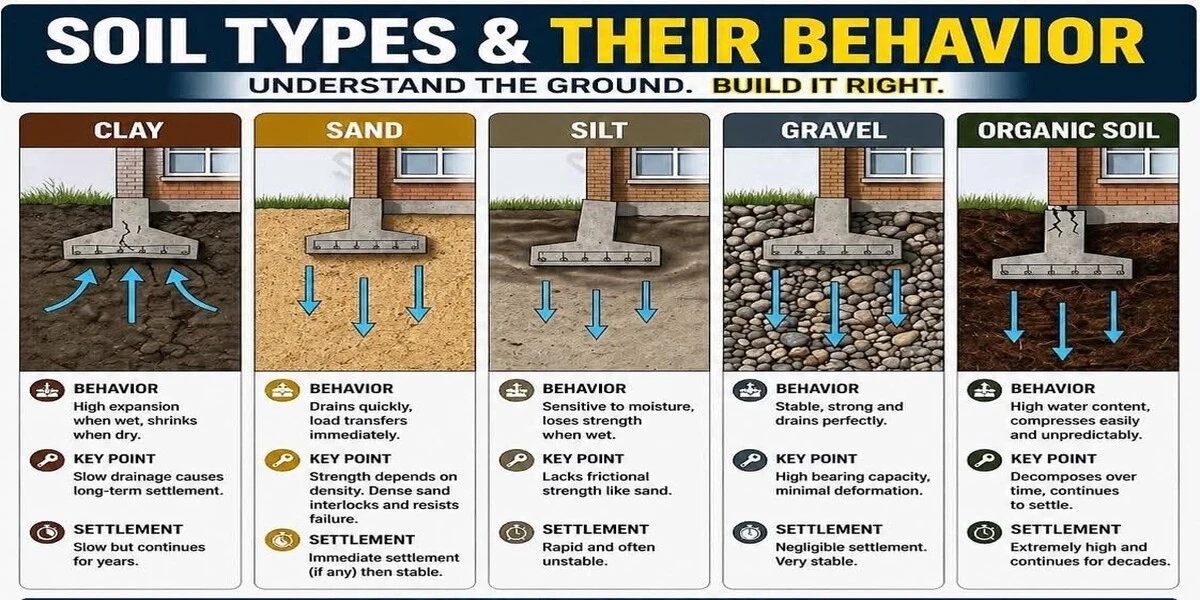
Soil is the natural material that supports the foundation. Different soils have different:
- Bearing capacities
- Compressibility
- Permeability
- Shear strength
- Swelling and shrinkage characteristics
The same foundation that performs well on dense sand may fail on expansive clay. This is why Geotechnical Engineering investigations are essential before construction.
The behaviour of soil is controlled by
The following are the behaviours that control the soil:
- Grain size
- Permeability
- Water movement
- Particle interaction
- Internal friction
In simple terms, the way soil reacts to load depends on how its particles rearrange, how water escapes, and how friction is generated inside the ground.
And THIS is what determines whether your building stays stable… or starts settling.
Properties of the soil
(a) CLAY SOIL: The Silent Mover. Clay may look strong today, but over time, it slowly compresses as water escapes from tiny pores.
Result on Clay soil?
- Long-term settlement
- Slow deformation
- Cracks appearing years later
Buildings on clay can continue to settle for years.
(b) SANDY SOIL: Fast Load Transfer. Sand transfers load immediately through grain-to-grain contact.
The secret is DENSITY:
- Dense sand = grains interlock tightly
- Better friction
- Higher strength
Results of Loose sand?
- That’s where trouble begins.
(c) SILT SOIL: The Dangerous Middle Child. Silt is finer than sand but coarser than clay. And honestly
Engineers don’t trust it easily. Why? Because silt is extremely sensitive to moisture.
- Rapid settlement
- Unstable behavior
- Weak frictional strength compared to sand
Add water, and stability can disappear FAST.
(d) GRAVEL: The Engineer’s Favourite. Large rock fragments. Strong. Stable. Reliable.
Gravel provides:
- High bearing capacity
- Excellent drainage
- Negligible settlement
Why it performs so well: The gravel particles form a strong “stone skeleton” that carries the load with minimal deformation.
This is one of the BEST natural foundation materials.
(e) ORGANIC SOIL: The Foundation Nightmare. This soil contains decaying plant matter and very high water content. And Civil Engineers? They absolutely DISLIKE it.
Why? Because organic soil behaves unpredictably:
- Extreme settlement
- Continuous compression
- Long-term decomposition
- Structural instability
Some organic soils can compress to a fraction of their original size and continue settling for DECADES.
REAL ENGINEERING TRUTH: A strong building on weak soil. It is still a weak building.
Foundation Type vs Soil Type Comparison Table
The following are the comparison between the foundation type vs Soil type.
| Soil Type | Bearing Capacity | Settlement Risk | Recommended Foundations |
|---|---|---|---|
| Gravel | Very High | Low | Isolated, Strip, Raft |
| Dense Sand | High | Low | Spread Footings |
| Loose Sand | Moderate | Moderate | Raft, Piles |
| Silt | Moderate | High | Raft, Piles |
| Clay | Low to Moderate | High | Raft, Under-reamed Piles |
| Expansive Clay | Low | Very High | Under-reamed Piles |
| Peat | Very Low | Extreme | Piles |
| Rock | Extremely High | Negligible | Direct Footings |
How Engineers Select the Right Foundation
Conduct a Soil Investigation
Field and laboratory testing typically include:
- Boreholes
- Standard Penetration Test (SPT)
- Cone Penetration Test (CPT)
- Atterberg limits
- Consolidation tests
Determine Structural Loads
Estimate loads from columns, walls, and slabs.
Evaluate Settlement
Both total and differential settlement must remain within acceptable limits.
Assess Groundwater Conditions
High water tables may reduce effective stress and complicate construction.
Compare Construction Costs
The technically feasible option is not always the most economical.
Frequently Asked Questions
1. Which soil is best for foundations?
Rock, gravel, and dense sand generally provide the highest bearing capacity and lowest settlement.
2. Which soil is worst for foundations?
Peat and highly organic soils due to very low strength and extreme compressibility.
3. Can clay support buildings?
Yes, but foundation design must address settlement and shrink-swell behavior.
4. When are piles required?
When surface soils are too weak or compressible to support the structure economically.
Final Takeaway
Before designing any foundation, understand the SOIL first. Because in construction, the ground always has the final say.
Foundation design is fundamentally an interaction between structural loads and subsurface conditions.
The correct foundation type depends on soil strength, compressibility, groundwater, structural demand, and economic constraints.
As a civil engineer, understanding the relationship between foundation type and soil type is essential for safe and durable construction.
A modest investment in geotechnical investigation can prevent severe structural and financial consequences later in the project lifecycle.
In engineering practice, the principle remains simple: match the foundation to the soil, and the structure will perform as intended.
Tell me. Which foundation do you use most on your site? Drop your answer in the comments form below.
Like Our Page On Facebook | Share — to educate another engineer today!
Thats All.